
Curriculum Leader: Mrs Fletcher
The Music Department provides opportunities for all students to develop their performing, composing and listening skills. Students are encouraged to develop their confidence, independence and teamwork while exploring their voices and instruments such as the ukulele, keyboard and djembe drumming through a range of musical genres.
Students are encouraged to listen widely and experiment creatively with musical ideas, performing to a high standard in every lesson.
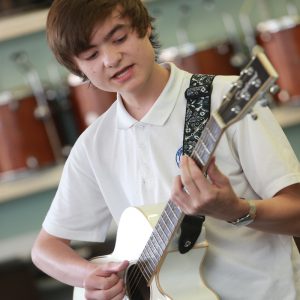
The Music Department is proud to support and extend the emerging skills and talents of our students through a broad extra-curricular programme and provision of peripatetic instrumental lessons.
We offer the following instrumental lessons in school:
- Upper strings (violin and viola)
- Classical/electric/acoustic guitar
- Singing
- Piano/keyboard
- Drums
- Woodwind
- Brass
- Theory/composition
Please read the letter here with further information about instrumental/singing lessons, which includes a link to the sign-up form. For any further information, please contact Mrs Fletcher directly by emailing fletcherh@fulford.york.sch.uk.
The Music Department fosters a sense of community cohesion through school concerts, extra-curricular activities and events with the wider community.
Extra-curricular music clubs, dates/times to be confirmed: Orchestra, Swing Band, Choir, School Production Band.
Throughout Year 7, 8 and 9 students develop their performing, composing and listening skills through a range of musical genres. Students have the opportunity to work independently, in groups and as pairs, with the opportunity to explore a range of instruments. The KS3 curriculum is designed to encourage students to develop a passion for music while preparing them for Eduqas GCSE Music should they wish to continue with their musical studies at this level.
Year 7
During Year 7 students will explore the following projects.
- Find Your Voice – developing singing technique and singing as an ensemble, while also exploring beatboxing and body percussion.
- Rhythm and Pulse – developing ensemble skills, rhythm reading and rhythmic composition using djembe drums.
- Keyboard Skills – developing note reading skills, culminating in a performance of a piece of music on the keyboard.
- Carnival of the Animals – students combine the skills they have gained throughout the year to compose a theme for a chosen animal, learning how to notate their music.
- Ukulele Skills – introduction to ukulele chords, developing tablature reading and ensemble skills.
- Written in the Stars – exploring rap, lyric writing, and developing ensemble performance skills.
Year 8
During Year 8 students will explore the following projects.
- Band Skills – developing ensemble performance skills to create an effective band performance.
- Programme Music – exploring how music can be used descriptively, and developing the reading of treble and bass clef. Exploring the instruments of the orchestra.
- Film Music – developing composition skills. Students will explore how to create a piece of music to fit with a given film clip, exploring the techniques used by film and video game composers. Students will explore music technology and instrumental techniques to create compositions for a film trailer.
- The Blues – exploring the roots of Jazz, Blues and Rock ‘n’ Roll music; developing performance, listening and improvisation skills.
- Theme and Variations – exploring composition techniques to develop a melody; developing performance, listening and composition skills.
Year 9
During Year 9 students will explore the following projects.
- Band Skills – developing ensemble performance skills to create an effective band performance.
- Video game music – using instruments and music technology to compose a video game soundtrack.
- Folk Music – listening to and performing a range of folk melodies, and exploring how these are often fused with other musical styles.
- Reggae – developing performing, composing and listening skills, leading to the creation of a Reggae song and suitable lyrics.
- Battle of the Bands – students combine the skills they have gained through KS3 in an ensemble performance of a chosen song.
Eduqas GCSE Music
Aim
To develop 3 areas of musical skills and knowledge.
- Composing
- Performing
- Listening with understanding
Type of Work
Composition can be for all types of instruments. You will build on the composition skills learned in KS3 to create music for your chosen instrument/s. You will explore how to write a detailed score using computer software, as well as how to develop ideas practically.
Performance: you will complete two assessed performances. You can either perform two ensemble pieces, or one solo and one ensemble. You should aim to perform a piece at ABRSM/Rock School (or other exam boards) grade 3 standard or above. Pieces of grade 4 standard and above will enable you to access the higher marks more securely.
Listening: Preparation for the Listening paper will involve learning about, and responding to, a wide variety of styles of music. There are 2 set pieces of music which you will study in detail for the final exam. The remainder of the exam involves responding to unfamiliar pieces of music and applying your understanding of the elements of music.
Eduqas Syllabus and Assessment
- Composition (30%): 2 pieces of music (combined duration recommended as 3-6 minutes). One is a free choice composition; the second is a choice of 4 briefs set by the exam board.
- Performance (30%): One solo piece and one ensemble performance OR two ensemble pieces. The total combined performance time must be at least 4 minutes, with at least one minute of ensemble playing.
- Listening (40%): Based around 4 Areas of Study.
- AOS1: Musical Forms and Devices
- AOS2: Music for Ensemble
- AOS3: Film Music
- AOS4: Popular Music
Link to specification: https://www.eduqas.co.uk/qualifications/music-gcse/#tab_overview
- Information for current students: Instrumental lessons letter 2025-26
- Information for our new Y7’s: Instrumental lessons letter 2026-27